Rooms of the Mansion
Discover Antiques, Fine Art, and Collectibles Showcased in Every Beautiful Room
The Rooms
Interpreted in both the Federal and Empire periods in which the house was built and expanded, Historic Strawberry Mansion houses antiques, fine art, and collectibles from the 18th and 19th century, including a noted collection of dolls from the High Street Exhibit of the Sesquicentennial of 1926.
During the original furnishing of the Mansion, in 1931, the Committee of 1926 treated each individual room of the house as a separately interpreted space. Different women’s groups involved in the High Street Exhibit, as well as some individuals, were assigned to curating the different rooms and gathering the beautiful pieces. As such, each room in the house has a unique interpretation and the diversity and contrast among the rooms has been enjoyed and celebrated by the public since the Mansion first opened for tours.
The Ballroom
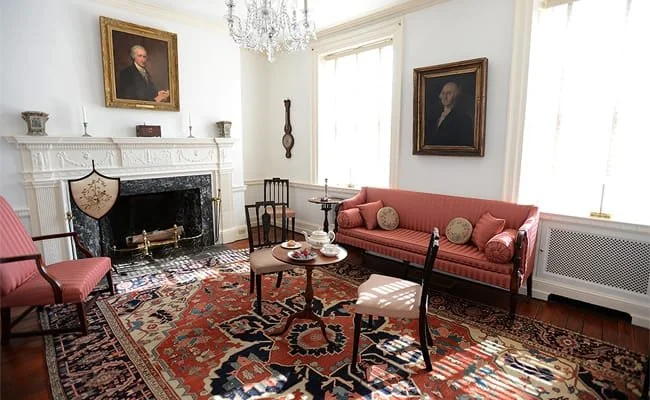
The Lewis Parlor, also known as the 18th Century Parlor, was decorated and continues to be maintained by the Pennsylvanian Society of New England Women (PSNEW). PSNEW was in charge of the Paul Revere Forge in the High Street Exhibit.
This room is furnished as it might have been at the time of Judge William Lewis’ occupancy. The focal points of the room are the reproduction Gilbert Stuart portrait of Judge William Lewis and the gorgeous Wellford mantle whose ornamental design was done by Robert Wellford dated in 1798. The mantle consists of hand-applied plaster and gesso decorative work surrounding King of Prussia marble.
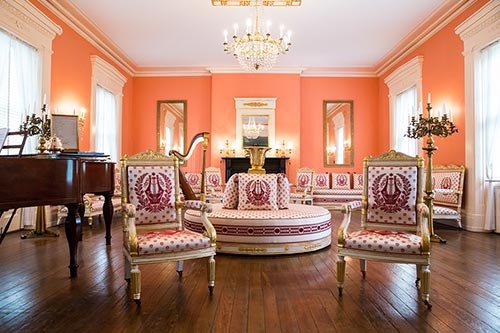
The Ballroom was decorated by the Foreign Relations Committee from the Sesquicentennial celebration, who were also in charge of the Stephen Girard house at the High Street Exhibit.
The Stephen Girard house was furnished in both French and American fashion in honor of Stephen Girard, a prominent merchant, financier, and philanthropist in Philadelphia who was born in France in 1750.The same blend of French and American taste was used in the Ballroom at the Historic Strawberry Mansion.
The focal point of the room is the French furniture of General George Cadwalader. General Cadwalader purchased the furniture in the ballroom in Paris in 1835 for his Philadelphia home. The Cadwalader family donated the suite to the mansion in 1964. Since then, it has been restored and reupholstered.
The harp in the ballroom was made in 1850 by J.P. Brown & Co., New York. It has been a part of the mansion’s collection since the museum opened in 1931.
The Lewis Parlor
Library/Reception Room
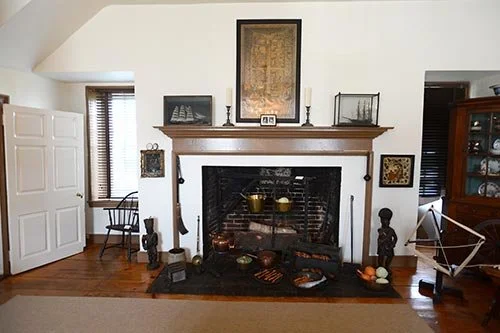
The Indian Queen Room
The Indian Queen Room was decorated by the Federation of Women’s Clubs responsible for the Loxely House at the High Street Exhibit, as well as the Emergency Aid of Philadelphia group responsible for the Indian Queen Tavern at the High Street Exhibit. The Indian Queen Tavern operated at the Sesquicentennial as an “old time restaurant,” and the Indian Queen Room is furnished in the same fashion.
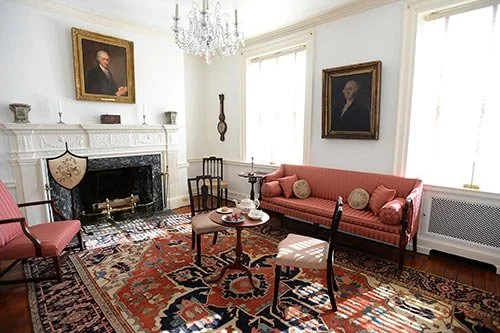
Mrs. Cyrus Curtis, wife of the founder of the Curtis Publishing Company, publishers of the Ladies Home Journal and other important magazines and newspapers, was directly responsible for the furnishing and décor of the 19th century parlor or library, also known as the Reception Room.
Mrs. Curtis’ original furniture purchase from American Art Galleries, in New York City, consisted of two mirrors, a pair of side chairs, a marble top table, two small tables, two arm chairs, a sofa, and a pair of urns. The purchase came to a grand total of $723 in 1931.
The Banquet Room
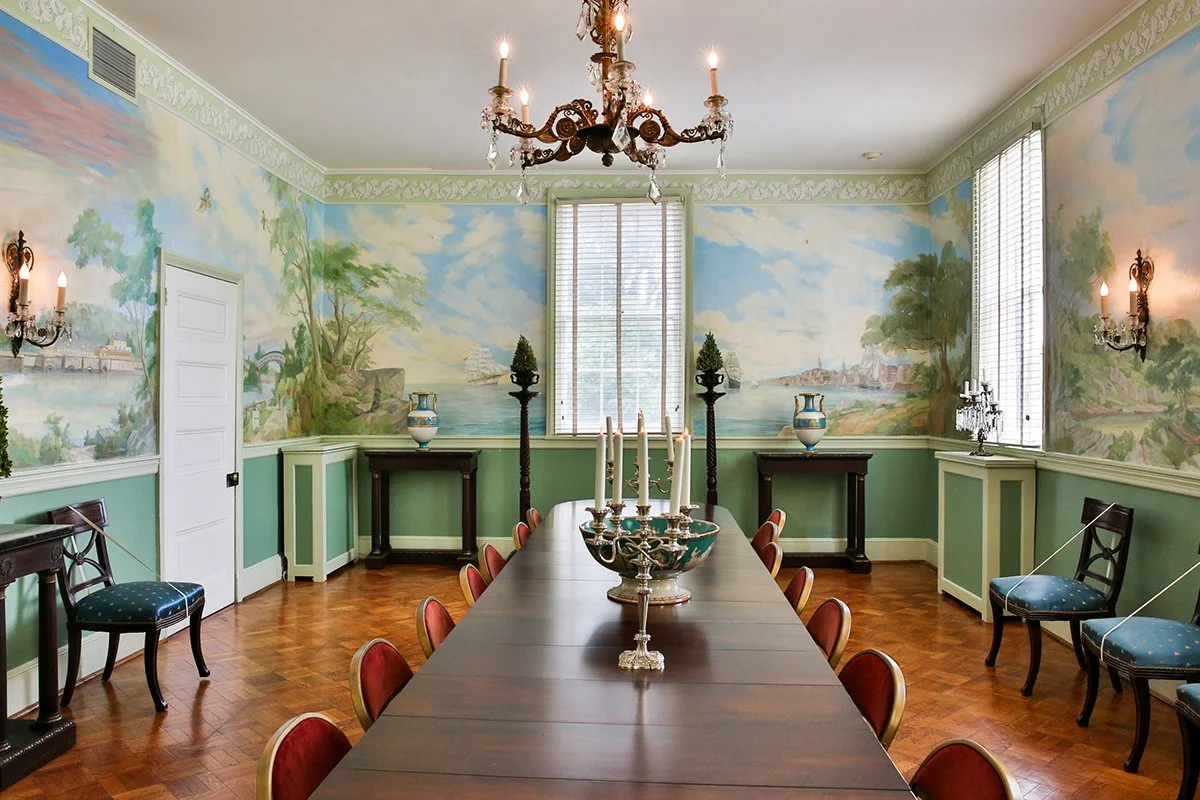
The Banquet Room was originally decorated by the Good Housekeeping Studio, in charge of the Dr. William Shippen house on High Street.
Because this room is in one of the Greek Revival wings, the decision was made to decorate it in the fashion of the 1830s. The furniture is a 1930 reproduction of 1830’s Empire style.
After the 2009-2013 Restoration project, a mural on canvas was affixed to the walls, depicting scenes around Philadelphia and Fairmount Park and highlighting the influence and time of Judge Hemphill. The mural, titled The Portage Trail to Strawberry Mansion, was painted by muralists Dot Bunn and Patrick Connors. Oil paint was donated by Vasari Classic Artist’s Oil Colors.
The Jefferson Dining Room
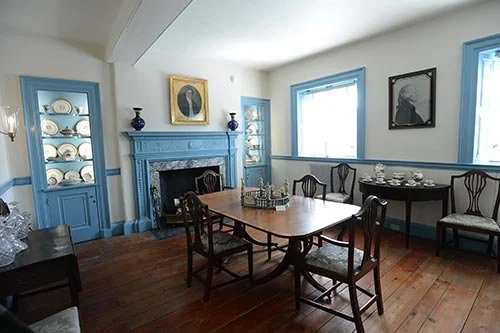
The Jefferson Dining Room was decorated by the Jefferson Committee, in charge of the Jefferson House in the High Street Exhibit.
Furniture for the house and the dining set on display in this room were provided by Strawbridge and Clothier, who constructed reproduction designs based on Jefferson’s actual furniture. The reproductions were used as floor displays at the Strawbridge and Clothier showroom, and these exact designs were available for purchase in 1930.
The Gillingham Bedroom
Decoration for the Attic was placed under the supervision of Mrs. Hampton L. Carson, wife of a prominent Philadelphia lawyer.
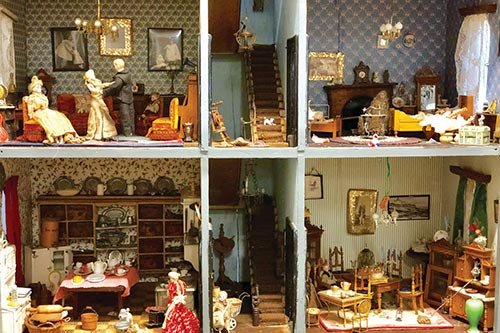
It contains a collection of toys, artifacts, and lifestyle items from the 18th and 19th centuries, including an outstanding dollhouse.
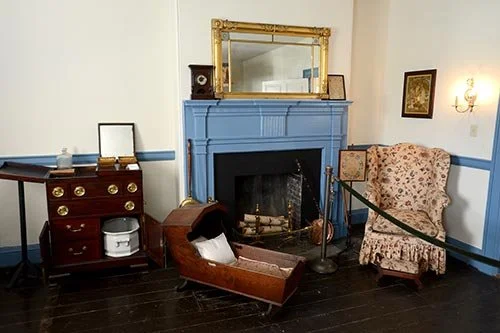
The decorations and furnishings in the Gillingham Bedroom, also called the 18th Century Bedroom, were a gift of Mrs. Harold E. Gillingham, a founding member of the Committee of 1926.
Both Mr. and Mrs. Gillingham were collectors of fine antiques and furniture. Mr. Gillingham wrote several articles on Philadelphia history.
The Attic